
After the first week of “value eating” I have to say there was not a meal I was not happy. I savored the tastes of beautifully crafted foods, like the superb organic lamb bratwurst or the fantastic artisan baguette. I had tasty eggs from happy chickens. Yummy milk with cream on top! And a whole lot I ate from The Scrumptious Pantry. Cosimo’s Olive Oil, Fabio’s & Nicoletta’s Rice & Cornmeal. Roberta’s Roasting & Grilling Salt and Spreads gave a special twist to my meals.
So were these cheap meals? Probably not. You could have probably spent less on milk, eggs, rice. Would the taste have been the same? Probably not. I enjoyed every bite, eating slowly as to keep the tastes alive as long as possible. As a result, I ate fairly small quantities (at least to my understanding). And the average food cost per day was about 5$! I admit two dinners are not included in this calculation, cause they were not eaten at home. But 5$ per day for a food that nourished body and soul does not seem exaggerated to me! How much is a Value Meal at the Golden Arches these days?? Guess I have to stop by tomorrow to find out!
So, this was week 1. Curious to see if and how the pricing changes once I can cook more elaborate meals.
Before I forget, the calculations for day seven of “Value Eating”:
Late Breakfast: a slice of Pumpernickel which I bought at Aldi, yes, yes, I know not the source for the most sustainable food, but Aldi for us ex-pat Germans is like a delicatessen, as we can get some food there not available in other markets (at least I have not found a source for artisan pumpernickel in the Windy City). Anyhow. From The Scrumptious Pantry I took a Roberta’s Sun-dried Tomato Spread and dolloped it on the pumpernickel (about 1 tablespoon. It is so rich in taste, you really only need a little for full sunny tomato taste), I topped the yummy-ness with two farm fresh eggs sunny side up (advice on a side note: eggs sunny side up are really difficult to fry in a pot. When you do not have a pan, boil your eggs...) fried in organic olive oil and then sprinkled some of Roberta’s Roasting & Grilling Salt on top. This came with a cup of organic green tea. Cost: 16c bread, 79c tomato spread, 82c for two eggs fried in 25c of olive oil and 5 cents for the herbed salt (248 pinches to go!), tea bag 6c = 2.13$
As afternoon snack I heated a cup of the farmstead’s milk (31c) and dissolved a piece of dark chocolate (35c) for a soothing hot drink. The chocolate I bought at Aldi, as well. They have my favorite German chocolate brand. I just love the way Europeans do their chocolate. Over Christmas I had a long discussion with my family over which chocolate to buy given the child labor in the cocoa plantings… Should we stop buying brands which are not clearly marked “fair trade”? We decided to continue buying the chocolate we always buy, but to write letters to the company’s customer service asking them about the labor practices in the plantings they buy from. I firmly believe that you as a critical consumer can stimulate change when asking questions. Boycotts though are not the right thing. What are these kids to do, if they have no more work in the plantations? Yes, the conditions there suck. It is heartbreaking. It has to be changed. But remember when years ago the rug industry started the fair trade mark on rugs? It is proven that the biggest part of those kids that lost their job in the rug workshops ended up prostituting themselves. Sometimes, we have to think what results we really want to achieve and what side effects our chosen path can have. So I dissolved my chocolate in my milk and hoped that my letter to the producer would maybe maybe start a process somehow.
Dinner was a nice spicy chili. I totally love chili. Could have it every day. What I love most about it, is how the intonations of the various chili peppers intermingle with the sweetness of the tomato. Sigh… For real great sweet tomato in your chili you really need tomatoes canned at the perfect moment. Really something you would want to remember to do in summer. Now, given that I had to leave the contents of my pantry behind in Italy (thanks, FDA, what harm could my canned tomatoes have done to the USA?), I had to use store bought. Where another level of difficulty was added – the current lack of a can opener. So I bought a ready sauce cause that comes with a twist cap. Marinara sauce (what the hell that is I did not understand. There are Marinara sauces in the store which have “Parmesan Cheese” on their ingredient list?? Gracious, I do not even want to start discuss Parmesan & Parmeggiano at this point, but how can you cook a cheese in a tomato sauce that is to be canned?). It was organic Marinara sauce though, and the less adulterated kind I could find. Came with a price tag of 2.29 for 25 oz. and was the most acid, unbalanced tomato sauce I can remember tasting. But then again, I have not tasted ready made sauces for a long time. A can of diced organic tomatos at 1.49 for 30 oz would certainly have been the better deal taste wise, but as I said: no can opener. Blame US customs for having pulled my container for inspection. Well, this is what I did with it: browned 1.5 organic onions in 2 tablespoons of olive oil. Added organic beans (1.5 cups in their dried state, but of course they had been soaked and pre-cooked a while) and half of the sauce. Chilli pepper, cumin, salt. And had it simmer for 90 minutes. Served on Fabio’s & Nicoletta’s rice from The Scrumptious Pantry very yummy and very filling and very nutritious and will last also tomorrow at only 75c (onions), 50c (olive oil), 84c (beans), 25c for spices and 1$ for rice = 3.34$
Total food cost for today: 4.46$ (assuming that half of the chilli will be eaten tomorrow).
Showing posts with label Mission. Show all posts
Showing posts with label Mission. Show all posts
Tuesday, January 26, 2010

Thursday, January 21, 2010
Day 1 - Value Eating on 01/20/10
Well, these first days of my posting might be pretty uninspiring. I just moved into a new apartment, but my furniture has not arrived yet, so all my kitchen is equipped with besides the stove is a pot, a wooden spoon and a knife.
Anyways, one has to eat and so I had
Breakfast
I had bought an insanely good artisan baked baguette at the Dill Pickle Co-Op grocery store. Just delicious. Perfect for breakfast with fig jam! So now, I had 1/4 of baguette, which would translate to 87 cents. The jam was homemade, but if it had been a store bought organic jam I guess I would have had to pay 7$ for the jar. So the two tablespoons I enjoyed on the bread were another 88 cents. Add one orange at 56 cents. I only drink hot water for breakfast, so total cost for my breakfast was 2.33$
Lunch
Another sandwich, that baguette is to die for! I boiled two happy eggs from a local farmer (again bought at the Dill Pickle) and sliced them onto my sandwich after drizzling the baguette with 1 tablespoon of Cosimo's Extra Virgin Olive Oil and sprinkled some of the super flavorful Roasting & Grilling salt Roberta does back in Vinci. Ok, so now for costs: two eggs 41cents each, 1/4 baguette for 87 cents, the pinch of salt... now that is tricky... I have to admit without my kitchen scale, it is difficult to asses how many pinches in one jar. I approximated about 250. Will double check once my kitchen scale get's here. A pinch of salt equals approx. 5 cents. A tablespoon of the olive oil (assuming we have 45 tablespoons in one bottle) is 70 cents. So my lunch sandwich came with a price tag of 2.44$. Again, drinking hot water (this will be the boring part of this blog. It is either hot water of wine)
Afternoon snack: one organic apple (50cents) and one delicious red carrot (20cents) I bought at the Green Grocer on 1402 W. Grand Street = 70 cents.
Dinner: Given the desperate state of my kitchen I went for dinner with my Cousin, so no local sustainable dinner tonight, but a burger. But I had organic lamb bratwurst planned with yams and potatoes!
90 days of value eating.
Ok, another one. Another self experiment posted online. I know we thought we had read them all: blogs and books keeping diaries of how they cooked their way through Julia Child, hunted & gathered in a 100 miles or 250 mile radius or within the borders of their home state. How they stopped to contribute to carbon emissions. So I am not going to copy those. I promise.
But now that I have taken on the widespread prejudice that eating organic/sustainable/real food is too expensive, I will now keep an online expense account of my meals. So the "value" in the title of this experiment does not relate to monetary value. It is about eating according to my own personal values.
I will not eat exclusively local food, cause I love the pungent Tuscan olive oil and a nice bottle of imported wine. I will not necessarily only eat from farm to table, cause sometimes an ingredient you need is not available directly. And maybe not all of it will be 100% organic. I will just continue eating as I did before, only change to my behavior being this online record. Fancy meals one day and a sandwich the other. I have no intentions of kicking off a discussion of the nutritional value of the food I consume, or on cooking skills. Although I appreciate any comment suggesting changes either in my diet or ideas of how each meal could taste better, it is first and foremost about money. How much does eating according to my values cost?
Friday, January 15, 2010
The Economics of a Value Meal
2010 has started well - at least when it comes to discussions in the media and various online forums about local eating, sustainable farming, Michelle Obama & the White House garden, Michael Pollan's "Food Rules"... hope this momentum keeps going.
One statement that can be read over and over again is that local, organic, small-farmer farmed food is more expensive, hence it is supposedly out of reach for most people and only something the overly rich can spoil themselves with.
WRONG. What most of the debate fails to mention are external costs.
The average packaged food available in supermarkets is heavily processed. It is sure not healthy, if I may challenge the LA Times (http://www.latimes.com/features/food/la-fo-calcook6-2010jan06,0,6888223.story). If we as a society were to consider the future costs of today's food production & eating to the bill, boy, would everyone be surprised how expensive today’s mass-produced fare is. The long term cost for society of these foods and their production is enormous, if directly on our health (allergies, diabetes, obesity, five year old girls in puberty), or indirectly through the environment like C02 emissions, soil erosion… the list goes on. And it is our tax dollars eventually paying for it.
We need some respected economists to use all their skill to come up with a number. How much does a Value Meal really cost??
Sunday, September 6, 2009
On Olives and Water
Picture yourself in the Tuscan countryside. With a glass of wine in your hand. On the terrace of a small farmhouse surrounded by vineyards, you take in the beautiful countryside, the vines standing in perfect formation, just like disciplined miniature soldiers (of the peaceful kind). Your gaze wanders over the rolling hills, you watch people harvesting grapes, happily bringing the fruit in the cellar. You hear children laughing loudly, as they play hide and seek in the vineyards, their hiding places being told by their dogs which are curiously running back and forth. What a happy scenery! Then you glance at one of the old olive trees mightily lining the estate
**Screetch **
And that is when all happiness comes to an abrupt hold. Because what you see are shriveled somethings, shadows of what the olives should be like at this time of year. Weak and tired they struggle to hold onto the branches that should nourish them, feed them water, make them grow until their green skin seems to be bursting from the juice that has build up inside.
Not so. This summer of 2009 was hot. Too hot. And dry. Too dry. And it is not only the olive trees suffering. After all, these are the strongest and most independently minded plants around. Peppers have been practically burned up before they ever had a chance to grow. Eggplants dried up on the vine. Berries never reached maturation. Water is life. And without water, we are in serious trouble.
Why no irrigation you might ask? Well, yes, irrigation would solve a pressing situation in a year like 2009 has been. But what are the long term impacts of irrigating? Of lowering the levels of the ground water? Because irrigation always also means pumping water out of their safe wells. None of the water used for irrigation ever finds its way back into the depth of the soil.
What is worrying us farmers here that there are no “normal” years anymore. Seasons have merged or plainly disappeared. There are no weather patterns to count on anymore. It is, as if we had completely lost touch with nature. And nature is our vocation, our life, not just what feed us (and you).
I surely have no answer, I surely do not know where to start to resolve this problem. So if you were expecting a solution from this post, I am sorry to disappoint you. But maybe this post is increasing awareness among all those of you who live in environments that lack the intense daily contact with nature. And maybe one of you has an idea, the solution, our salvation?
Saturday, August 8, 2009

Tuesday, July 14, 2009
What's special about specialty food?
 Back from the "Fancy Food Show" in New York, the leading marketplace for specialty food in the US. Back with a huge sense of disappointment.
Specialty food seems to be reduced to chocolates, tea and various salsas and sauces. But the sad thing is that it seems that there is no difference if they were made in Maine, Florida, Texas or California. Peach salsa everywhere… Chipotle everywhere...ah yes, and now everything is "natural".

How come that in a country as vast as the US with all the different zones, climates, ethnical influences and heritages those producers who call themselves "special" predominantely have these standardized products? How come that there is more industrial made food at a show like that than artisan one? Is calling your product "natural" or targeting it to a special diet group all that it takes to be special? Is it not about being different from the mass-marketed, processed food products? Of creating food that tastes of terroir?? That tells a individual story???
There has to be someone in the Midwest making a unique yambutter and someone in California that catches the Mexican and Asian influences and interprets them in a novel way. The question we have to ask us: What is the signature crop/produce of an area/state? What are the signature tastes? Who puts it together in a jar/bottle/box? Does anyone?
Monday, May 25, 2009
Food on Film
When we think about movies on food, we think of romantic comedies such as “Bella Martha/No reservations” or of documentaries like “Supersize me”.
As the second edition of the Slow Food Film Festival in Bologna successfully demonstrated, there is a huge number of interesting, heart warming, heart wrenching, agitating, documentaries about the state of our foodworld out there waiting to be watched and talked about!

In three days of festival alone I caught 22 documentaries and most of them were totally worth watching them. Only challenge: to remain cheerful and happy on day three. Cause all these films present the world of agriculture, farming and eating with all its dysfunctions and very little things that seem to go right.
My personal favourite was the film “Over Land” by Steve Sudermann, who follows the decline of his family’s farm in Quebec, Canada, over a period of more than two years, until the moment when they have to sell, leaving the soil they had worked for generations.
Another great film was “La Vie Moderne” not only for content, but also for the camera - the director, Raymond Depardon, is a magnum photographer and that tells. But it is another story of families that leave the soil (this time in France), cause the hilly land does not permit high density farming and hence does not bring economic return to those working there. Depardon shows a young farmer who cannot wait to run off the land and work in a nearby hotel, an old farmers who sell their last cow, cause at the age of 94 tending for a cow is a difficult thing to do, and who suffers terribly, as the cow was the farmer’s reason of being, his life. And all these stories make you wonder: is there no hope? How are we supposed to feed the world, if small scale quality farming becomes unattractive?
Not even large scale farming necessarily helps to make ends meet, cause as the story from Canada shows, you can work hard, achieve great results, even being nominated “top 8 supplier” to McCain French Fries, but the numbers do not turn nevertheless…. 2,000 farmers close their farms in Canada every year.
Last film deserving special mention: Goede Vissers (The Good Fishermen), portraying a Dutch couple dedicated to sustainable fishing. Great people that were also present at the screening to discuss, debate and taste their delicious products (see picture).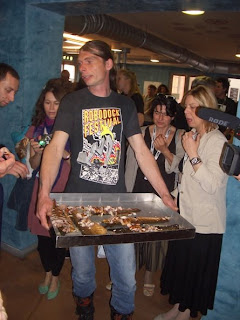
We, the consumers, need to start demanding real food from real people, hoping that market logic does apply and demand will create supply, as the initiatives of large scale retailers pushing into organic food show. Not that organic necessarily supports small artisan farming, but it is a first step as it demonstrates an increased awareness by the consumers.
In this sense, the Slow Food on Film Festival was a great event to create awareness. Cause on thing is to read about the sad state of agriculture and farming on the news – even if I experience every day myself how difficult it is to make ends meet in quality farming – and another to have numbers turn into stories and stories to have faces.
As the second edition of the Slow Food Film Festival in Bologna successfully demonstrated, there is a huge number of interesting, heart warming, heart wrenching, agitating, documentaries about the state of our foodworld out there waiting to be watched and talked about!

In three days of festival alone I caught 22 documentaries and most of them were totally worth watching them. Only challenge: to remain cheerful and happy on day three. Cause all these films present the world of agriculture, farming and eating with all its dysfunctions and very little things that seem to go right.
My personal favourite was the film “Over Land” by Steve Sudermann, who follows the decline of his family’s farm in Quebec, Canada, over a period of more than two years, until the moment when they have to sell, leaving the soil they had worked for generations.
Another great film was “La Vie Moderne” not only for content, but also for the camera - the director, Raymond Depardon, is a magnum photographer and that tells. But it is another story of families that leave the soil (this time in France), cause the hilly land does not permit high density farming and hence does not bring economic return to those working there. Depardon shows a young farmer who cannot wait to run off the land and work in a nearby hotel, an old farmers who sell their last cow, cause at the age of 94 tending for a cow is a difficult thing to do, and who suffers terribly, as the cow was the farmer’s reason of being, his life. And all these stories make you wonder: is there no hope? How are we supposed to feed the world, if small scale quality farming becomes unattractive?
Not even large scale farming necessarily helps to make ends meet, cause as the story from Canada shows, you can work hard, achieve great results, even being nominated “top 8 supplier” to McCain French Fries, but the numbers do not turn nevertheless…. 2,000 farmers close their farms in Canada every year.
Last film deserving special mention: Goede Vissers (The Good Fishermen), portraying a Dutch couple dedicated to sustainable fishing. Great people that were also present at the screening to discuss, debate and taste their delicious products (see picture).

We, the consumers, need to start demanding real food from real people, hoping that market logic does apply and demand will create supply, as the initiatives of large scale retailers pushing into organic food show. Not that organic necessarily supports small artisan farming, but it is a first step as it demonstrates an increased awareness by the consumers.
In this sense, the Slow Food on Film Festival was a great event to create awareness. Cause on thing is to read about the sad state of agriculture and farming on the news – even if I experience every day myself how difficult it is to make ends meet in quality farming – and another to have numbers turn into stories and stories to have faces.
Monday, April 13, 2009
The Omnivore's Dilemma - Another Must Read
 Everyone pondering over the question which book to read next, here is your answer: Michael Pollan's "The Omnivore's Dilemma" is a brilliant account of our nation's food politics, eating habits and challenges of small-scale, sustainable agriculture. You will be surprised when Pollan (Professor of Science and Environmental Journalism at the University of California, Berkeley) traces down all the components that hide behind the unfamiliar sounding ingredient list of packaged foods, amused when he buys a steer to better understand the food chain and feeling hungry when he convinces a San Francisco friend of Italian origin to take him hunting in the San Francisco woods for wild pigs to be turned in home cured prosciutto.
"The Omnivore's Dilemma - a natural history of four meals" gives a deep insight into today's way America is eating by following three food chains: the industrial, the organic, and the hunter-gatherer.
A must read for every food conscious eater!
Wednesday, March 11, 2009
Fields of Plenty - A Must Read!
 You know these moments when you find an unexpected treasure? An antique gold rimmed Rosenthal plate for a buck in the garage sale, for instance. I had this sensation when I stumbled across Michael Ableman's book "Field of Plenty" in a used bookstore some time ago. It is an enchanting set of stories about real farmers across the US, making real food and creating great products that make consumers like you and me happy. Michael, an old school farmer himself, sets out one summer in an old camper to see for himself if there are other likeminded, quality driven farmers that strive for natural products. And he writes about these encounters with the love only a farmer can have for the land and the products it bears. The stories are matched with great pictures and recipes from the farmers his trip has brought him to.
A must read for food believers! A feel good book that leaves you happy and hungry for the next farmers' market. And the best: I just checked on amazon.com and they are having a sale on this book! Enjoy the read!
Monday, February 23, 2009
How to make food
No, contrary to what you might think this is not another great recipe for Italian food (no need to be sad about that, will post some soon enough).... This is your guide to actually make food where it all begins: in the fields of a farm!
A great many people always look at me with this dreamy look, "oh, agricultre...I always wanted to work on a farm for a couple of weeks." So then, go, what are you still waiting for??? Just join this fabulous non profit organization named WWOOF (World Wide Opportunities on Organic Farms) and before you know, you are picking peaches in South Africa, or harvesting rice in Indonesia, or making Cheese in Ireland and and and. Yes, you can come to Italy, too.
The trick is to become a memember of the national WWOOF organization of the country in which you want to work (for example the annual membership fee for Italy is 25 EUR). As soon as you have paid your membership, you will get a directory of all associated farms that swap room & board against your helping hands. And the best thing: as it is cultural exchange, all visa and insurance formalities are taken care of. Go to http://www.wwoof.org/ for more info!
And if you want to come to Italy, consider joining Cosimo in laying the groundwork for the new olive oil!! Read Matt's account on his time with at Cosimo's farm: http://www.mattartz.org/category/travel/page/2/
Monday, November 3, 2008
Quo Vadis, Salone del Gusto?
Last week was the week of the “Salone del Gusto” in Turin, in Italy. Organized by Slow Food as the showcase of artisan food, it was supposed to be a celebration of producers that handcraft traditional products, grow their food with care and are committed to keeping food traditions alive.
So, did the Salone del Gusto achieve this mission? I tend to give a negative answer. To me, the Salone del Gusto has lost its focus and I mourn the spirit with which it was run in the early days.
Slow Food certainly needs to be credited with the fact that it has created a huge PR machine that get’s the word on artisan food out there. A look at the long lines of people waiting to buy a ticket Sunday at 10.30am was the best proof – tickets that at a 20 Eur price point are everything but cheap – the same amount can buy you three tickets to the movies or a dinner in a Pizzeria, including an appetizer and a desert, just to give you an idea. It is a great achievement to get that many people curious about food and wanting to experience the Salone del Gusto.
Some of the exhibits that had been developed were splendid interactive and educational experiences. The region of Emilia-Romagna for example staged a show that communicated the value of such a basic staple as our daily bread. Three actors on stage five times a day, involving passers-by to get their hands “dirty” in flour and dough, explaining the process of bread baking, the properties of natural yeast and getting people to listen and smile. I am trying to convince technology to let me post the video for you to get an idea of the spirit that was buzzing around the stand, with everyone chanting “uno-due-tre, il pane lo faccio da me” (one-two-three, my bread I bake myself).
Certainly no doubt about the exhibits of the so called “Presidia” – these are groups of artisans collaborating in order to grow plants/raise animals threatened by extinction or to produce traditional foodstuff whose recipes would otherwise be forgotten. The underlying philosophy is that of “if you want to save it, eat it”. So Slow Food is promoting these foodstuff in Presidia, creating a demand and a market for these foods and hence incentivizing more artisans to join in the production. The Presidia presentation was a big celebration of local tastes and cultures: from Sicilian beans to French ham made of a black hog to vanilla from Mexico – producers were explaining their products, exhibiting their projects and discussing their food history and culture with the visitors. It was all that Slow Food is.
Besides these highlights, the Salone was one big market where all sorts of food producers had paid a lot of money to sell their products to the masses. And while it is absolutely legitimate to give a small butcher shop with exceptional products the chance to present his mastery in the “street of the butchers”, it is absolutely not acceptable that industrial producers are allowed into the event, exhibiting monster-sized prosciutto vacuum packed in shiny and colourfully branded aluminium wraps. That is NOT Slow Food. It is prostitution. As are the collaborations with the big industrial food brands such as Lavazza Café. They are one of the main sponsors of the Salone del Gusto, so all other small coffee roasters are banned from being present. And that in a country that has such a rich variety of coffee tastes and such a rich history of brewing this delicious hot, strong and black drink.
As far as I see it, Slow Food has found a cash cow and they are milking it to finance their other activities, such as the Terra Madre convention that took place in parallel to the Salone and gave farmers and chefs and other professional food people from all over the world a chance to discuss the future of sustainable food production. Which is a worthy cause and which I support with all my heart. But the fact remains, that the Salone has lost its soul and this is a pity, cause Slow Food risks to loose its position as “artisan food champion” and legitimate lobby for artisan food producers and consumers! Slow Food will certainly need to start a discussion on how to move ahead and to decide its mission statement. I, as a long time follower of Slow Food, have my doubts about where we are going with this.
So, did the Salone del Gusto achieve this mission? I tend to give a negative answer. To me, the Salone del Gusto has lost its focus and I mourn the spirit with which it was run in the early days.
Slow Food certainly needs to be credited with the fact that it has created a huge PR machine that get’s the word on artisan food out there.
 A look at the long lines of people waiting to buy a ticket Sunday at 10.30am was the best proof – tickets that at a 20 Eur price point are everything but cheap – the same amount can buy you three tickets to the movies or a dinner in a Pizzeria, including an appetizer and a desert, just to give you an idea. It is a great achievement to get that many people curious about food and wanting to experience the Salone del Gusto.
Some of the exhibits that had been developed were splendid interactive and educational experiences. The region of Emilia-Romagna for example staged a show that communicated the value of such a basic staple as our daily bread. Three actors on stage five times a day, involving passers-by to get their hands “dirty” in flour and dough, explaining the process of bread baking, the properties of natural yeast and getting people to listen and smile. I am trying to convince technology to let me post the video for you to get an idea of the spirit that was buzzing around the stand, with everyone chanting “uno-due-tre, il pane lo faccio da me” (one-two-three, my bread I bake myself).
Certainly no doubt about the exhibits of the so called “Presidia” – these are groups of artisans collaborating in order to grow plants/raise animals threatened by extinction or to produce traditional foodstuff whose recipes would otherwise be forgotten. The underlying philosophy is that of “if you want to save it, eat it”. So Slow Food is promoting these foodstuff in Presidia, creating a demand and a market for these foods and hence incentivizing more artisans to join in the production. The Presidia presentation was a big celebration of local tastes and cultures: from Sicilian beans to French ham made of a black hog to vanilla from Mexico – producers were explaining their products, exhibiting their projects and discussing their food history and culture with the visitors. It was all that Slow Food is.
Besides these highlights, the Salone was one big market where all sorts of food producers had paid a lot of money to sell their products to the masses. And while it is absolutely legitimate to give a small butcher shop with exceptional products the chance to present his mastery in the “street of the butchers”, it is absolutely not acceptable that industrial producers are allowed into the event, exhibiting monster-sized prosciutto vacuum packed in shiny and colourfully branded aluminium wraps.
 That is NOT Slow Food. It is prostitution. As are the collaborations with the big industrial food brands such as Lavazza Café. They are one of the main sponsors of the Salone del Gusto, so all other small coffee roasters are banned from being present. And that in a country that has such a rich variety of coffee tastes and such a rich history of brewing this delicious hot, strong and black drink.
As far as I see it, Slow Food has found a cash cow and they are milking it to finance their other activities, such as the Terra Madre convention that took place in parallel to the Salone and gave farmers and chefs and other professional food people from all over the world a chance to discuss the future of sustainable food production. Which is a worthy cause and which I support with all my heart. But the fact remains, that the Salone has lost its soul and this is a pity, cause Slow Food risks to loose its position as “artisan food champion” and legitimate lobby for artisan food producers and consumers! Slow Food will certainly need to start a discussion on how to move ahead and to decide its mission statement. I, as a long time follower of Slow Food, have my doubts about where we are going with this.
Friday, October 24, 2008
400 cows in six bites
On a recent trip to Florence I was drawn into the local outlet of an international fast food chain, which is conveniently situated within the train station. Being the sole destination for tourists that do not trust Italian food (unfortunately there are still a lot of them, but that will be the topic for another post), I am sure it is the most successful restaurant in the whole city - economically speaking.
Curiosity guided me through the doors: I wanted to eat a Hamburger. I wanted to see how long it would take me to eat 400 cows. Or the meat of 400 cows. A recent statistic I read in one of the many food magazines that are sent to me on a weekly basis confirmed that the average meat patty contains the meat of 400 cows. I found that a) very impressive and b) very frightening. I was even more frightened at the sight of this thin burger patty in front of me, which weighted a maximum of 200 grams. I tried to map out a pattern of 400 squares on its surface, but I quickly gave up. 400 cows for 200 grams of meat. That is half a gram per cow!
Shaking my head, I wondered where our food production has gone to.
But then the confusion set in. When do we know that we have crossed the line towards industrial food production? Let me give you an example: to produce our Sangiovese wine, we harvest two hectares. A total of 10,000 vines, which carry about 12,000 kg grapes, which in turn can be transformed into 9,600 bottles of wine. In realty, to produce a single bottle of wine, we would just need 8 vines, just as one cow would have been plenty for a beef patty. Of course, this is an extreme example, but is there a difference between 12,000kg of grapes going in to a bottle of wine and 400 cows going into a meat patty?
I guess the question at hand is: were those 400 happy cows? Cows that were raised in the open, had the chance to munch on some grass and run around and play, when they felt like running or playing? Did they have someone that gave them a name? Or were they raised in the dark, chained to concrete floor and fed with hormones to grow fat in the right places?
In order to make the right decision on what food products we buy, which ones we choose to nourish not only our body, but also our soul, we need to know where our food comes from. Who is raising the cattle, growing the vines and milling the grain. We need to be sure that our alimentation is in the hands of proud craftsmen that work with integrity. The famer that raises healthy cattle in an healthy environment, a butcher that buys his meat from a trusted farmer. Then, and only then, 400 cows in a burger patty might be acceptable.
Subscribe to:
Posts (Atom)


